Before making this activity a few years ago, I polled my beginner Spanish students about the most well-known families from a TV show or movie. The Kardashians won, but Family Guy consistently took second, ¡so I went with la familia Griffin!
First, we watch the video below together to provide comprehensible input for introducing family vocabulary. I pause frequently to ask «circling» style questions, all in the target language, Spanish. (Click here for a great video on circling by Kaizen Teaching).
Finally, students put what they learned into production by writing a similar description of a family on the back of the handout. Here are the instructions I project on the board:
¡A escribir! Descripción de una familia Use theFamilyGuypresentation as a model
Describe una familia famosa(de la televisión, el cine, un libro, la historia, etc.)
Usa el vocabulario para expresar las relaciones entre los miembros de la familia.
¿Qué hacen los miembros de la familia?
–Escribe 1-3 frases sobre cada persona.
Dibuja (draw) un árbol familiar.
I instruct the students who finish writing early swap papers to do peer editing.
Any feedback welcome in the comments! I´d love to know if you use this activity in your classroom or have any suggestions for expansion/improvement!
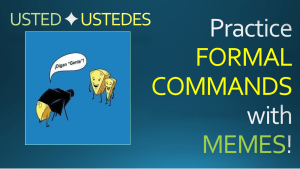
Here is the latest video in the «Practice Spanish with Memes» series! In this video we start with a quick review of how to conjugate formal (USTED y USTEDES) commands & where to place the pronouns. Then it’s on to the memes!
Last week, a student emailed me that she was watching our «Direct Object Pronouns: Practice with Memes» video with her 11-year-old son, and he wanted to know what my very favorite meme in Spanish was! Our email exchange got me excited to make another video with more memes!
Here’s the latest video in the «Practice with Memes» series! It is meant to be a fun way to help students practice with stem-changing verbs, expand vocabulary, and especially to invite them to explore the Spanish-speaking world through the internet!
Many students are surprised to see that there are memes and YouTube videos in Spanish just like the ones they like in English. I hope that the memes video series can be just one way to encourage these sorts of connections between students’ interests and Spanish language learning!
And here’s a link to see all the memes and posts on this site categorized to stem-changing verbs! Stem-changing verbs posts
I have observed that many students in my most advanced courses still struggle with numbers above one hundred. Here is a video I made to go over things step-by-step.
This first video covers 100s through 900s, and the next one will be practice (with memes!) with the thousands up to the millions!
This relaxing story is a great way to practice narration in the past (preterite and imperfect) and calm down a rowdy classroom!
You can download PDFs of the free activity sheet and answer key below. The writing prompt on the handout can also be modified as a conversation activity (or as both).
Memes are a great way to illustrate/review grammatical concepts and expand vocabulary!
One of the first goals of this website was to provide an organized site that I could refer to my students to find memes for fun practice on their own. I was not comfortable referring them to the original sites where I find the memes because there is a lot of inappropriate/offensive content. Furthermore, here I can narrow the selection to what will be most helpful for students and categorize them by topic.
Students respond very well to the incorporation of memes into the classroom. I use memes as a basis for quick conversation/analysis while illustrating target grammatical concepts. Since my goal in the classroom is to maximize communicative activities and maintain conversation in Spanish-only, I am working on a video series that has more slow-paced, English-based explanations of how these memes illustrate the grammatical concepts. My hope is that it will be an interesting way to review and/or present the material in a different way.
I am working on making more videos this summer because in Fall I will be teaching more «blended» classes with less time in the classroom and more time in online learning. The goal is not to assign my videos to students, but to offer them as a resource for further explanation/exploration/review that will complement our in-class communicative activities. This is the first «meme-based» video, so feel free to give me any constructive criticism!
The word «time» in Spanish can be translated to Spanish in several different ways! This is a source of confusion for many of my students, so I made this video to explain which words to use depending on the intended meaning of «time» in different contexts.
In this video I share the 3 tips I use to explain Spanish vowel pronunciation.
Follow up comprehension questions:
(1)What are the 5 vowels in Spanish?
(2) What is a tense vowel? Which vowels are tense in Spanish?
(3) What is an example of a vowel sound that we use in English but not in Spanish?
See below for answers.
1. A, E, I, O, U
2. Our muscles are more tense and engaged when we pronounce tense vowels. All vowels in Spanish are tense vowels (A, E, I, O, U).
3. Answers will very. Some include the «A» in «cAt,» the «I» in «kId» or «fIt,» the «uh» in «bUg» or a relaxed pronunciation of «edUcation.»
I have found that when students are able to answer these questions about Spanish vowel pronunciation, they are able to analyze and self-correct their own pronunciation.
By answering these questions, students demonstrate that they know which vowels to stick to, which vowel sounds to avoid, and physically how Spanish vowels are pronounced in contrast with the lax vowels in English pronunciation that so often interfere with their Spanish pronunciation.
This tense vs. lax distinction is superior to the «short» versus «long» vowel explanation commonly found in textbooks because it allows students to make a physical connection to the vowel pronunciation (by placing the hand on the cheek to feel the tense cheek muscles.)
Furthermore, vowel length is variable, so the «short» versus «long» distinction can be unclear and cause confusion.
Do you have any other tips you think should be included in Spanish vowel pronunciation instruction?
I have been using the song «Humano» by Lido Pimienta for years after seeing it on Zachary Jones´ fabulous website. (Click here for a link to Zachary Jones´ post about this song.) I made this video of the song to visually reinforce geography by showing country names and images as she sings each nationality, as well as conjugations of SER and adjective agreement (humano vs. humana). I have also found that projecting a visual aid helps keeps students focused during such a soothing song. Enjoy the video!

 Before making this activity a few years ago, I polled my beginner Spanish students about the most well-known families from a TV show or movie. The Kardashians won, but Family Guy consistently took second, ¡so I went with la familia Griffin!
 Here is the latest video in the
  Last week, a student emailed me that she was watching our
  In this video, we change the affirmative tú commands in memes to negative ones and vice versa to review and practice step by step with funny examples.

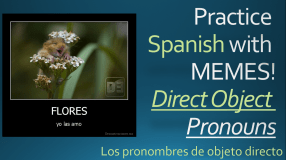 Memes are a great way to illustrate/review grammatical concepts and expand vocabulary!
 The word «time» in Spanish can be translated to Spanish in several different ways! This is a source of confusion for many of my students, so I made this video to explain which words to use depending on the intended meaning of «time» in different contexts.
 estudiafeliz